
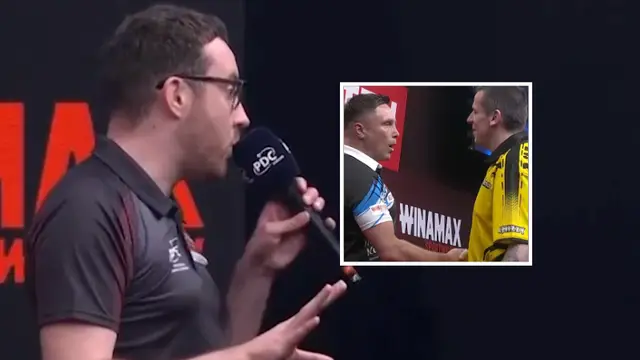
In the heart of the bustling Glaspalast arena in Sindelfingen, Germany, the European Darts Grand Prix was alive with the kind of electric energy that makes professional darts one of the most captivating sports on the planet. The second-round clash between two heavyweights, Gerwyn Price and Dave Chisnall, had everything fans crave: razor-sharp checkouts, thunderous 180s, and a crowd that was equal parts passionate and rowdy. Yet amid the cheers and the tension of a high-stakes battle, one moment stood out, not for a spectacular dart, but for the calm authority of referee Huw Ware. His decisive intervention against a disruptive whistling crowd has since earned him widespread acclaim, reminding everyone why he remains one of the most respected officials in the Professional Darts Corporation.
The match itself was a classic encounter between contrasting styles. Price, the fiery Welshman known as the Iceman, came into the contest riding a wave of strong form this season, his aggressive approach and pinpoint accuracy often turning arenas into cauldrons of intensity. Chisnall, the unflappable Englishman nicknamed Chizzy, brought his trademark consistency and smooth throwing action, capable of grinding out results against the very best. From the opening leg, the pair traded blows in a best-of-eleven legs thriller that kept the capacity crowd on the edge of their seats. Chisnall edged ahead to take a narrow 3-2 lead, capitalizing on a few missed opportunities from Price. The atmosphere was thick with anticipation, the kind where every throw could shift the momentum dramatically.
But as the legs progressed, something unwelcome began to creep into the proceedings. Persistent whistling and jeering erupted from sections of the crowd, a tactic that has unfortunately become all too familiar at overseas events on the PDC European Tour. The noise was not the harmless banter that adds color to darts nights; it was targeted and malicious, timed to coincide with players’ setups and throws. It disrupted the rhythm, testing the concentration of both athletes at a critical juncture. Darts demands laser-like focus, where the slightest distraction can mean the difference between a 140 finish and a missed double. With Chisnall holding that slender advantage, the whistling intensified, threatening to overshadow what should have been a pure showcase of skill.
That was when Huw Ware stepped forward, quite literally. The Welsh referee, never one to shy away from maintaining order, marched to the edge of the stage. Dropping to one knee for emphasis, he addressed security staff before turning to the microphone and delivering a message that cut through the arena like a perfectly aimed dart. In a firm, clear voice that carried the weight of authority, he declared: “Ladies and Gentlemen, I just told security if you carry on whistling please do, but you’ll be thrown out the venue immediately. It’s just so you know, OK?” The words hung in the air, direct and uncompromising. Ware was not pleading; he was setting a boundary, making it crystal clear that such behavior would not be tolerated.
The response from the crowd was immediate and telling. A loud round of applause rippled through the Glaspalast, signaling that the vast majority of fans appreciated the stand being taken. Order was restored almost instantly, allowing the players to refocus without the cloud of disruption hanging over them. The match resumed its natural flow, and Price, drawing on his renowned resilience, powered back into contention. He broke Chisnall’s throw at a pivotal moment and went on to claim a hard-fought 6-4 victory. The Iceman posted an impressive average of 99.71, smashing home five maximum 180s along the way, a performance that showcased his ability to rise above the chaos. Chisnall had pushed him every step, but Price’s experience and finishing prowess proved decisive, booking his place in the last 16 against Chris Dobey and keeping alive his bid for the £30,000 top prize.
What made Ware’s handling of the situation so praiseworthy was not just the intervention itself, but the way it exemplified his broader approach to refereeing. Darts crowds are legendary for their passion, from the singalongs to the sea of colorful shirts, but the rising tide of whistling has become a persistent headache for players and officials alike. It is especially prevalent at European stops, where home support can sometimes cross into unsportsmanlike territory. Ware has confronted this issue head-on before, earning a reputation as the referee who refuses to let a minority spoil the spectacle for everyone. Just weeks earlier, during another European Tour event in Göttingen, he had stepped in during Stephen Bunting’s match against Niko Springer. In that crucial final-leg decider, Ware had politely but firmly told the crowd: “I’ve asked politely once and I’ll say it politely, shut up please. We’re trying to have a game of darts up here, make this sound better please.” Bunting later voiced his frustration on social media, noting how a small group’s actions had tainted an otherwise great contest despite the dedication players pour into their craft.
Ware’s consistency in addressing these disruptions stems from a deep respect for the game and those who play it. In interviews, he has spoken candidly about the frustration it causes, emphasizing that there is no excuse for maliciously trying to put an opponent off. He understands the delicate balance referees must strike—wanting to see a fair, high-quality contest while managing rowdy environments without escalating tensions further. Sometimes a quiet word off-mic or a gesture to security suffices, but when the noise becomes relentless, as it did against Price and Chisnall, Ware does not hesitate to use the microphone. His actions send a powerful message: the oche is a place for skill and sportsmanship, not sabotage.
Social media lit up almost immediately after the incident, with fans from around the world hailing Ware as a hero of the sport. One supporter captured the sentiment perfectly, writing, “Huw is the only ref with a set of stones on him, got to stand up to these idiots.” Another echoed the praise: “This is why he is the best referee. Good at his job but consistently tries to do something about the whistlers.” A third added, “This is why Huw Ware is the best ref in the sport by a mile,” while a fourth noted, “As he should, it seems to be every week no matter the venue. He’s the only one that speaks up.” These reactions highlight a growing consensus that Ware’s firm yet fair style is exactly what darts needs to protect its integrity as it continues to grow globally.
Beyond the whistles and the win, the evening underscored the unique pressures faced by top darts professionals. Players like Price and Chisnall travel extensively, honing their craft through relentless practice and mental preparation, only to encounter environments where a vocal minority seeks to unsettle them. Ware’s intervention allowed the contest to breathe, letting the true drama of the darts unfold. Price’s comeback victory was not just about the scoreline; it was a testament to composure under trying conditions. As the tournament progresses, with stars like Michael van Gerwen and others advancing through their brackets, moments like these serve as reminders of the human element that makes the sport so compelling.
Huw Ware’s no-nonsense approach has solidified his status as a standout figure in the PDC. A Welsh official with a commanding presence and an unwavering commitment to fairness, he has officiated some of the biggest matches in the sport, including high-profile world championship stages. His willingness to confront issues like whistling sets him apart in a field where many might opt for silence to avoid confrontation. In doing so, he not only safeguards the players’ ability to perform but also enhances the experience for the genuine fans who come to celebrate the artistry of darts rather than disrupt it.
As the European Darts Grand Prix rolls on, the headlines may shift to quarterfinal thrills and potential title contenders, but Ware’s handling of the Price-Chisnall clash will linger as a standout example of leadership. It was a brief pause in the action, yet one that spoke volumes about respect, responsibility, and the enduring appeal of a sport where the referee’s whistle—metaphorical or otherwise—can restore harmony to the chaos. In the end, the real winners were the players who could focus on their craft and the fans who witnessed darts at its finest, free from unnecessary interference. Ware’s intervention ensured that the night belonged to the arrows, not the noise, proving once again why he is indispensable to the game’s continued success.
Leave a Reply