
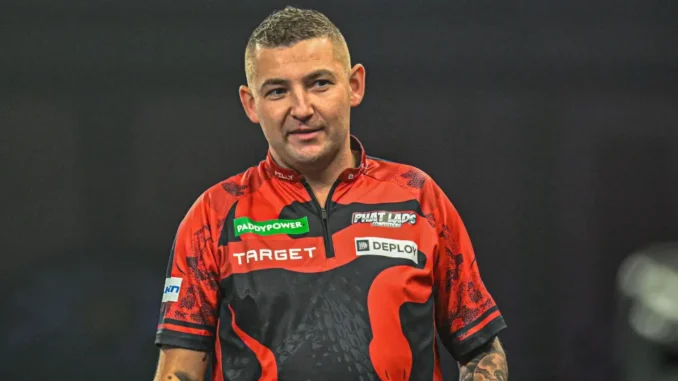
Luke Littler has found himself at the centre of a growing debate in darts after sections of crowds continued to boo the young world champion during Premier League events, sparking a strong and emotional defence from fellow professional Nathan Aspinall, who believes the reaction has gone too far.
The atmosphere surrounding Littler has become one of the defining storylines of the current Premier League season. At multiple venues across the campaign, the teenager has been met with boos during walk-ons and player introductions. While crowd interaction has always been part of darts culture, the intensity and consistency of the negativity aimed at Littler has raised eyebrows across the sport.
Despite the hostile reception in certain arenas, Littler’s performances have remained unaffected. If anything, he has continued to strengthen his reputation as the most dominant force in world darts right now. Night after night, he has delivered high-scoring averages, clinical finishing, and composed performances under pressure that have left opponents struggling to keep pace. His ability to maintain focus in loud and often hostile environments has become one of his most impressive traits.
It is this resilience that has prompted Aspinall to speak out strongly in his defence. The former major champion, who knows the pressures of top-level darts himself, did not hold back when addressing the treatment of the teenager. He expressed frustration at what he sees as unfair criticism and insisted that some fans need to rethink their behaviour and “sort their heads out.”
Aspinall’s comments reflect a wider concern among several players and figures within the sport who feel Littler is being unfairly targeted. According to him, the teenager is not only competing at the highest level but also carrying a significant responsibility for the growth of darts. He argued that Littler has brought fresh attention to the sport, attracting new audiences and increasing its popularity among younger viewers who previously had little interest in darts.
The rise of Littler has been nothing short of extraordinary. Bursting onto the professional scene as a teenager, he quickly became one of the most talked-about names in British sport. His rapid success, combined with his confidence on stage, has made him a global figure in darts almost overnight. With major titles already to his name and a growing list of records, he has established himself as the leading player of his generation.
However, such rapid success has also brought intense scrutiny. Some fans, Aspinall suggests, may be reacting out of frustration or even jealousy at how quickly Littler has risen to the top of the sport. In darts, where underdog stories are often celebrated, the emergence of a dominant figure so early in his career has created a polarising effect in some arenas.
There is also the natural rivalry element that cannot be ignored. Littler’s presence at the top of the game has intensified matchups with established stars such as Luke Humphries, Michael van Gerwen, and Gerwyn Price. These high-profile clashes often come with emotionally charged atmospheres, where crowd reactions can become more divided. In some cases, this has translated into boos aimed at the reigning champion, particularly when he is seen as the favourite or dominant force in a match.
Yet Aspinall insists that none of this justifies the treatment Littler has received. He believes the teenager deserves recognition and respect for what he has already achieved at such a young age. In his view, very few players in the history of darts have handled pressure as well as Littler, especially given the speed at which his career has developed.
One of the most striking aspects of Littler’s rise is his composure. Despite still being in his teens, he consistently performs on some of the biggest stages in the sport without showing signs of nerves. Whether it is a packed Premier League arena or a world championship final, he appears calm, focused, and unfazed by external pressure. That mental strength has become a defining feature of his game.
His dominance in recent seasons has also contributed to the growing narrative around him. Littler has claimed multiple major titles, including world championship victories that have firmly established him at the top of the sport. His success has not only made him the man to beat but has also created a situation where opponents and fans alike expect him to win almost every time he steps onto the oche.
This level of expectation inevitably brings pressure, but Littler has so far shown little sign of struggling under it. Instead, he has continued to deliver top-level performances, often responding to hostile crowds with even stronger displays. In several matches, boos from the crowd have appeared to fuel his focus rather than disrupt it, as he produces higher scoring spells and crucial finishes in key moments.
Aspinall’s defence also highlights a broader issue within darts culture. While crowd interaction, banter, and psychological pressure are long-standing parts of the sport, there is a growing discussion about where the line should be drawn. Many believe that targeting a young player who has done so much to elevate the game may be crossing that line, particularly when the criticism becomes persistent and personal in tone.
At the same time, Littler himself has shown little interest in escalating the situation. He has often downplayed the boos, suggesting that he is used to it and that it does not affect his game. On occasions, he has even responded with humour, implying that fans attempting to distract him are wasting their time because his focus remains on winning matches and collecting trophies.
That mentality has helped him build a reputation as one of the most mentally strong players in modern darts. Even as a teenager, he is being spoken about in the same breath as some of the sport’s all-time greats when it comes to composure and consistency. Many observers believe that if he continues on his current trajectory, he could dominate the sport for years to come.
Off the oche, Littler’s rise has also had a significant impact on the popularity of darts. Television audiences have increased, ticket demand has surged, and the sport has gained a noticeable influx of younger fans. His emergence has been credited with bringing darts into a new era of visibility, where it is now followed more closely by mainstream audiences than ever before.
Aspinall’s comments therefore reflect not just a defence of a fellow professional, but also a recognition of Littler’s wider contribution to the sport. In his view, it is important that fans appreciate what they are witnessing rather than undermining it with unnecessary hostility.
As the Premier League season continues, all eyes remain on Littler to see how he responds to both the pressure and the praise. If his recent form is anything to go by, he is unlikely to be derailed by crowd reactions. Instead, he appears more focused than ever on continuing his winning streak and further cementing his place at the very top of world darts.
Leave a Reply