
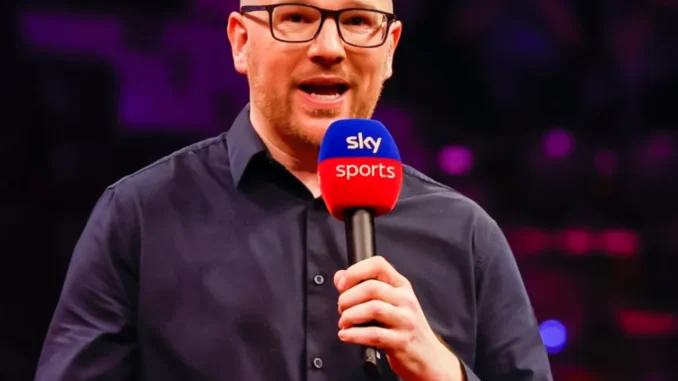
Former world darts champion and respected Sky Sports pundit Mark Webster has opened up about the health battle that has forced him away from television screens and darts arenas in recent months after being diagnosed with a rare form of blood cancer.
The Welshman, who remains one of the most recognisable figures in darts broadcasting, revealed he was diagnosed with hairy cell leukaemia earlier this year after initially noticing unusual fatigue and health issues that eventually led to further medical tests. The diagnosis came as a major shock, not only to Webster himself but also to fans of the sport who had grown used to seeing him regularly covering the biggest events in darts.
Webster, now 42, has become a hugely respected analyst and commentator since retiring from professional competition in 2019. His calm personality, tactical insight and deep knowledge of the game made him a popular member of Sky Sports’ darts coverage, while his absence from recent broadcasts had already sparked concern among viewers.
The former BDO world champion finally explained the reason behind that absence in an emotional interview where he detailed the difficult journey he has been facing behind the scenes.
“On January 8, I was diagnosed with a rare form of blood cancer called hairy cell leukaemia,” Webster revealed. “It sounds bad when you say leukaemia, but it’s got a good prognosis. Ninety-five per cent of cases are successful.”
Despite the encouraging outlook doctors have given him, Webster admitted the recovery process has not gone as smoothly as he had hoped. After beginning treatment earlier this year, he initially believed he would be able to return to work fairly quickly. Instead, lingering issues with his immune system and low white blood cell counts have delayed his comeback.
“I will be put into some sort of remission at some point,” he explained. “But the recovery at the minute is not going to plan in terms of the speed of it.”
The former world champion has undergone chemotherapy as part of his treatment, but doctors remain cautious about exposing him to crowded indoor environments while his immune system is still weakened. That restriction has effectively ruled him out from attending live darts events for the time being.
“My white blood counts are still not recovering,” Webster said. “So therefore my immune system is not great at the minute, hence why I can’t go back to work.”
For someone who has spent decades travelling the world around darts, first as a player and later as a broadcaster, adjusting to life away from the sport has been difficult. Webster admitted he misses the routine and energy of major tournaments, especially the atmosphere inside packed arenas during Premier League nights and televised events.
“It’s not the worst-case scenario, but it’s frustrating,” he admitted. “I’m used to being busy all the time.”
Webster last appeared on Sky Sports coverage during the Premier League Darts night in Newcastle back in February. Fans quickly noticed his absence from broadcasts in the weeks that followed, though Webster chose to keep the details of his illness private while focusing on treatment and recovery.
The popular pundit admitted he underestimated how long the recovery process would take after treatment began. At one stage, he believed he might be able to return to work within weeks, but repeated blood tests showed his body was still struggling to rebuild its immune defences.
“I thought I’d be back pretty quickly,” he explained. “But it hasn’t worked out like that.”
Doctors have advised Webster to avoid environments where he could be exposed to infections due to his weakened immune system. Darts venues, often packed with thousands of fans, are considered too risky at this stage of his recovery.
“I can work with people, but just in sensible environments,” he said. “The places I normally work in aren’t ideal right now.”
Hairy cell leukaemia is a rare type of blood cancer that affects the bone marrow and blood cells. The condition develops slowly compared to some other forms of leukaemia, and treatment success rates are generally high. However, recovery can vary significantly between patients, especially after chemotherapy treatment weakens the immune system.
Webster revealed that fatigue was one of the earliest warning signs that something was wrong. He noticed he was becoming increasingly tired and lacking energy, prompting further medical investigations that eventually led to blood tests and a bone marrow biopsy.
The diagnosis marked a deeply emotional moment for the former champion, who has remained one of the sport’s most admired personalities throughout both his playing and broadcasting career.
Webster first rose to prominence in the darts world during the BDO era, becoming one of Wales’ most successful players. His crowning achievement came in 2008 when he captured the BDO World Championship title at Lakeside after defeating Simon Whitlock in the final.
That victory established Webster as one of the leading names in the sport and paved the way for his eventual move to the PDC. He later enjoyed more memorable moments on the biggest stage, including reaching the semi-finals of the PDC World Championship at Alexandra Palace on two occasions.
Known for his composed style and consistency under pressure, Webster earned widespread respect from fellow professionals throughout his career. Even after stepping away from competitive darts in 2019, he remained heavily involved in the sport through television work.
His transition into punditry proved seamless. Fans appreciated his honest analysis and ability to explain the tactical side of darts in a calm, engaging way. Over the years, he became a trusted voice during major tournaments, often praised for his balanced opinions and knowledge of the players.
Now, however, the focus has shifted entirely toward his health.
Webster revealed he continues to undergo regular hospital appointments and weekly blood tests as doctors carefully monitor his recovery. He is also receiving booster treatments designed to help improve his immune system and increase his white blood cell counts.
“I’ve got to trust the people looking after me,” he explained. “They’ve been really good with me through everything.”
The former world champion admitted there have been moments of disappointment during recovery, especially when tests showed his progress was slower than expected. He even believed at one point that he might return for a Premier League event in Brighton, only for doctors to advise against it after further blood results.
“I got a bit carried away thinking I might be able to come back,” he admitted. “But my blood counts were still too low.”
Despite the setbacks, Webster remains determined to stay positive and patient while continuing treatment. He said the support he has received from fans, fellow players and people within the darts community has meant a huge amount to him during the difficult period.
Messages of support have poured in from across the sport since news of his diagnosis became public, with many fans hoping to see him back on television screens in the near future.
For now, Webster is focused entirely on regaining his health and allowing his body the time it needs to recover properly. While there is still no confirmed date for his return to broadcasting, his optimism remains clear.
“It’s just a case of trusting the process,” Webster said. “Hopefully it won’t be too much longer.”
Leave a Reply