
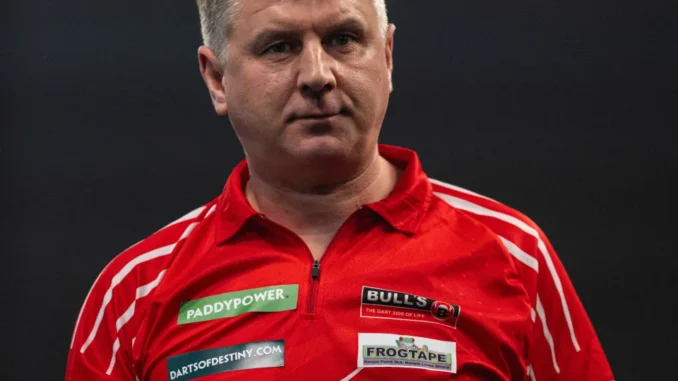
Tension and controversy briefly took centre stage at the European Darts Grand Prix when an unusual accusation left one of the sport’s most respected players stunned.
Dutch star Danny Noppert sparked the drama during his quarter-final clash with Poland’s Krzysztof Ratajski, alleging that his opponent was making distracting “clicking” noises with his darts mid-match. The unexpected claim added a layer of tension to what was already a finely balanced contest in Sindelfingen, Germany.
The match itself had been tightly fought, with both players trading legs in a high-quality encounter typical of the European Tour. Both men were locked in rhythm, producing steady scoring and clinical finishing, when the mood suddenly shifted. Noppert, visibly frustrated, raised the issue mid-game, believing the repeated clicking sound—likely caused by Ratajski adjusting or tapping his darts—was interfering with his concentration at the oche.
For Ratajski, the accusation came completely out of the blue and clearly caught him off guard.
“I was in shock,” he said afterwards, reflecting on the moment he was called out during such a crucial stage of the match. The experienced Pole insisted he had no awareness of doing anything unusual and certainly no intention of trying to distract his opponent.
“I didn’t notice anything,” he added, making it clear that he had not even realised there could be an issue until it was raised. From his perspective, it was simply part of his natural routine—handling his darts between throws as players often do—rather than any form of gamesmanship.
The situation did not escalate into any formal complaint or intervention from officials, and the match continued after the brief moment of tension. Still, the exchange added an extra psychological edge to an already high-pressure contest, with both players forced to reset mentally and refocus on their performance.
What followed was a dramatic and memorable finish that highlighted just how resilient top-level darts players must be under pressure. Ratajski found himself trailing 5-4, with Noppert on the brink of victory and just one leg away from closing out the match. At that critical moment, the Pole showed immense composure, surviving a match dart before producing a clutch response to stay alive.
From there, momentum shifted. Ratajski steadied himself, sharpened his finishing, and edged the deciding leg to complete a 6-5 comeback victory. It was a turnaround that demonstrated not only his technical ability but also his mental strength—particularly in light of the earlier distraction controversy.
The handshake at the end of the contest was brief but respectful, suggesting that while tensions had flared in the heat of competition, there was no lasting animosity between the two players. In a sport that prides itself on etiquette and mutual respect, such incidents are rare, but they can underline just how intense the competitive environment becomes at the highest level.
The episode also highlighted how finely balanced elite darts matches can be. At this level, where margins are razor-thin, even the slightest perceived distraction—whether real or imagined—can disrupt a player’s rhythm. For Noppert, who is widely regarded as one of the calmest and most composed figures on the circuit, the moment of frustration stood out as unusual.
Ratajski, meanwhile, used the incident as motivation and carried his momentum into the semi-finals. His run through the tournament had already been impressive, and the dramatic quarter-final victory only added to his confidence. However, his campaign ultimately fell just short of a place in the final.
In the semi-finals, he faced England’s Ross Smith in another high-stakes clash. The match proved to be a different kind of challenge, as Ratajski struggled early on with his finishing. He missed a string of darts at doubles—an uncharacteristic lapse that allowed Smith to build an early advantage.
Although Ratajski rallied and showed flashes of the form that had carried him through earlier rounds, the slow start proved costly. Smith held his nerve in the closing stages to secure a 7-5 win, ending Ratajski’s run just one step short of the final.
Despite the semi-final defeat, Ratajski’s overall performance at the tournament reinforced his reputation as one of the most consistent and dangerous players on the European circuit. His ability to stay composed under pressure—particularly after the quarter-final controversy—was widely noted, and his deep run added another strong result to his season.
The broader context of the tournament made the incident even more notable. The European Darts Grand Prix is a key event on the Professional Darts Corporation’s European Tour, regularly attracting a stacked field of top-tier players competing for significant prize money and ranking points. With so much at stake, emotions can occasionally boil over, even in a sport known for its discipline and focus.
While the tournament ultimately produced a deserving champion, it was moments like the Noppert-Ratajski clash that gave fans something extra to talk about. The brief controversy became one of the standout talking points of the weekend, sparking debate among viewers about concentration, sportsmanship, and the psychological side of the game.
In darts, silence and focus are crucial. Players rely heavily on rhythm and routine, and any disruption—no matter how minor—can feel magnified under the pressure of competition. Whether the clicking noise genuinely affected Noppert or was simply a momentary frustration is open to interpretation, but it served as a reminder of how mental the sport truly is.
For Noppert, the incident may be seen as a rare glimpse of vulnerability in an otherwise composed competitor. For Ratajski, it became a test of character—one that he passed by responding with resilience and performance rather than allowing it to derail him.
As the European Tour moves forward, both players will likely put the episode behind them and focus on upcoming events. Still, for those watching in Sindelfingen and fans following around the world, it was a moment that stood out—a rare flash of controversy in a sport defined by precision and control.
And for a brief moment, a simple “click” became the centre of attention on one of darts’ biggest stages.
Leave a Reply