
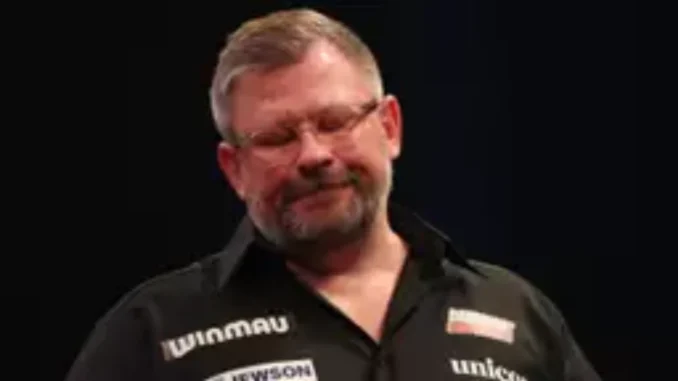
James Wade found himself under intense scrutiny following a dramatic opening match at the Winmau World Masters, as attention quickly shifted from his performance on the oche to questions about his conduct during and after the contest.
The experienced Englishman, famously nicknamed “The Machine,” battled through a tense first-round clash against Madars Razma in Milton Keynes. The match itself was a gripping encounter that swung back and forth, ultimately going down to a deciding leg before Wade secured a narrow 3–2 victory. It was the kind of performance that has defined much of Wade’s long career—resilient, composed under pressure, and ruthlessly efficient when it mattered most.
However, while the result highlighted Wade’s enduring quality and competitive instincts, the aftermath quickly became the main talking point. Within hours of the match concluding, Razma took to social media to share his disappointment, raising concerns not just about the crowd’s behaviour but also about what he perceived as Wade’s attitude both on stage and behind the scenes.
Razma’s comments suggested he felt a lack of respect following the defeat. He pointed specifically to what he described as an underwhelming handshake and a cold interaction away from the public eye. Although he stopped short of making direct accusations, the tone of his message made it clear that the experience had left a strong impression on him.
In his post, Razma acknowledged his status in the sport, noting that he comes from a smaller darts nation and is not among the biggest names on the circuit. Still, he questioned whether that should translate into negative treatment, particularly from the crowd. He expressed confusion over being booed and disappointment over how the post-match exchange with Wade unfolded, both in front of fans and backstage.
Despite the frustration, Razma attempted to move forward quickly. He emphasized that his focus was already shifting to upcoming tournaments, particularly events scheduled in Germany. His response struck a careful balance between expressing genuine disappointment and maintaining professionalism, but it was enough to spark widespread discussion among fans and analysts.
The incident reignited ongoing debates within darts about sportsmanship, respect between players, and the increasingly intense atmosphere at major events. With crowds becoming louder and more partisan, especially in televised tournaments, players are often forced to perform in emotionally charged environments where tensions can escalate quickly.
While Razma’s perspective drew sympathy from many supporters, Wade approached the situation from a more competitive standpoint. In his post-match reflections, he chose to focus on the significance of the victory and what it meant for his broader campaign. For Wade, the World Masters represents an important opportunity to rebuild momentum after a difficult end to the previous season.
He openly acknowledged that the latter part of his 2025 campaign had been frustrating. Early exits in key tournaments, including the World Championship, combined with the disappointment of not being selected for the Premier League, left him with something to prove. Despite those setbacks, Wade maintained that his overall season still contained strong performances and moments he could take pride in.
The omission from the Premier League appears to have had a lingering impact. Wade had previously shared his thoughts publicly, expressing a mixture of frustration and satisfaction with his efforts. His comments resonated with a segment of fans who believe that consistency and experience can sometimes be overlooked in favour of emerging talents or players enjoying short bursts of form.
At the same time, the situation with Razma has brought renewed attention to Wade’s long-standing reputation as one of darts’ most intense competitors. Throughout his career, he has built a legacy on mental toughness, focus, and an uncompromising approach to competition. Those qualities have helped him remain at the top level for many years, but they have also occasionally led to criticism when emotions run high.
Supporters of Wade argue that this fierce competitive edge is exactly what has sustained his success. They view his attitude as a reflection of his determination to win at all costs, a trait shared by many elite athletes across sports. Critics, however, suggest that moments like this highlight the need for a clearer balance between competitiveness and mutual respect.
For Razma, the episode has also underscored the challenges faced by players from smaller darts nations. Competing against established stars in front of large, often partisan crowds can be daunting, and recognition is not always evenly distributed. His comments struck a chord with fans who believe the sport should do more to ensure all players are treated with respect, regardless of ranking or reputation.
As the tournament progresses, the spotlight will remain firmly on Wade. His performances on the board will continue to draw attention, but so too will his conduct off it. Whether this incident fades into the background or becomes a defining storyline of his 2026 season may depend on how he responds in the coming rounds.
What is clear is that the match has sparked a broader conversation about the evolving nature of professional darts. The balance between passion, pressure, and professionalism is becoming increasingly delicate, particularly as the sport grows in popularity and intensity. Wade’s journey through the World Masters will now be followed with heightened interest, not just for his results, but for what it may reveal about the fine line between competitive fire and sportsmanship in modern darts.
Leave a Reply