
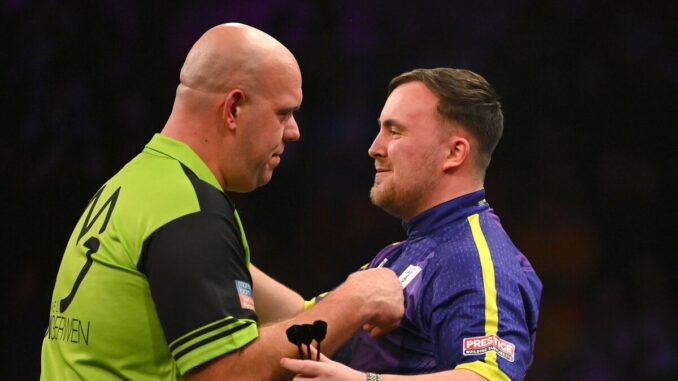
The remarkable rise of Luke Littler has not only reshaped conversations around young talent in darts, but also brought a wave of personality-driven stories that continue to capture fans’ attention. Among the more unexpected talking points to emerge during his breakthrough has been a blunt, two-word nickname handed to him by one of the sport’s biggest figures, Michael van Gerwen — a nickname that quickly spread across the darts world.
Littler’s emergence has been nothing short of extraordinary. Bursting onto the biggest stages as a teenager, he has gone toe-to-toe with seasoned professionals and often come out on top. His fearless approach, rapid scoring, and clinical finishing have made him one of the most exciting players to watch. Yet alongside his performances, it’s his personality and off-stage moments that have helped elevate his profile even further.
As his fame has grown, so too has his interaction with the sport’s established stars. One of the most notable relationships to develop has been with Van Gerwen, a dominant force in darts for over a decade and a multiple-time world champion. Their encounters on stage have already produced high-quality matches, with Littler showing that he can challenge — and even defeat — one of the greatest players of his generation.
Off the stage, however, their dynamic has revealed a more playful side. In a candid moment, Van Gerwen admitted that he had given Littler a nickname — one that was as direct as it was unexpected. Referring to the teenager as “kebab boy,” the Dutchman drew attention to one of Littler’s personal habits that had become widely known among fans.
The nickname stems from Littler’s own admission about his favorite post-match treat. The young star has openly spoken about enjoying a kebab after playing, a detail that quickly became part of his public image. Van Gerwen, known for his straightforward personality and sense of humor, seized on that detail and turned it into a nickname that immediately stuck.
“I call him kebab boy,” Van Gerwen revealed, delivering the line with characteristic bluntness. It was the kind of comment that could easily be misinterpreted, but in this case, it was clear that it came from a place of humor rather than criticism. In fact, the tone of the remark suggested a level of familiarity and comfort between the two players.
Nicknames have always been a significant part of darts culture. From dramatic walk-on titles to playful labels given by fans and fellow professionals, they help define personalities within the sport. Littler himself is widely known by his official nickname, “The Nuke,” a title that reflects his explosive scoring ability. However, Van Gerwen’s version offered something more personal — a nickname rooted in everyday life rather than performance.
For fans, the story quickly gained traction. It added another layer to Littler’s already compelling narrative, showing a more relatable side to a player who has often seemed beyond his years on the oche. The idea of a teenage darts sensation celebrating victories with a simple takeaway meal resonated with many, making him even more endearing to supporters.
At the same time, the nickname highlighted the camaraderie that exists within the professional darts circuit. While matches can be fiercely competitive, there is also a strong sense of mutual respect and shared experience among players. Banter and light-hearted teasing are common, especially between competitors who face each other regularly.
In the case of Littler and Van Gerwen, that balance between rivalry and respect is particularly evident. On stage, they are fully focused, each determined to come out on top. Off stage, however, there is room for humor and personality, which only enhances their rivalry in the eyes of fans.
Van Gerwen’s willingness to joke about Littler is also a sign of recognition. For a player of his stature to engage in that kind of banter suggests that he sees the teenager as a genuine competitor — not just a promising youngster, but someone capable of competing at the highest level. In many ways, being given a nickname by a legend of the sport is a form of acceptance.
Littler, for his part, has taken everything in stride. Since his rapid rise, he has faced intense media attention, constant scrutiny, and the pressures that come with being labeled a prodigy. Yet he has handled it all with a level of maturity that continues to impress both fans and fellow professionals.
Moments like this nickname incident are part of that journey. They show how quickly Littler has been absorbed into the culture of the sport, becoming not just a competitor, but a personality within it. His ability to laugh off such remarks and stay focused on his game speaks volumes about his mindset.
The story also reflects the broader appeal of darts as a sport that celebrates individuality. Unlike many other professional environments, darts allows players to express themselves freely, whether through their walk-on music, their interactions with the crowd, or the nicknames they carry. It creates a connection with fans that goes beyond results and statistics.
In Littler’s case, that connection has been strengthened by his authenticity. He hasn’t tried to change who he is despite the spotlight. Whether it’s his honest interviews, his relaxed demeanor, or even his choice of post-match meal, he remains relatable. That authenticity is a big part of why fans have embraced him so quickly.
As his career continues to evolve, it’s likely that stories like this will keep emerging. Every interaction, every comment, and every performance adds to the growing narrative around him. The nickname “kebab boy” may have started as a simple joke, but it has become part of the wider conversation about one of darts’ most exciting young talents.
Looking ahead, the rivalry between Littler and Van Gerwen promises to deliver many more memorable moments. Their matches will continue to draw attention, and their off-stage interactions will only add to the intrigue. For fans, it’s the perfect combination of elite competition and engaging personality.
Ultimately, the nickname says as much about the sport as it does about the players. It highlights the humor, the camaraderie, and the human side of professional darts. And for Littler, it’s just another chapter in a journey that is already proving to be anything but ordinary.
Leave a Reply