
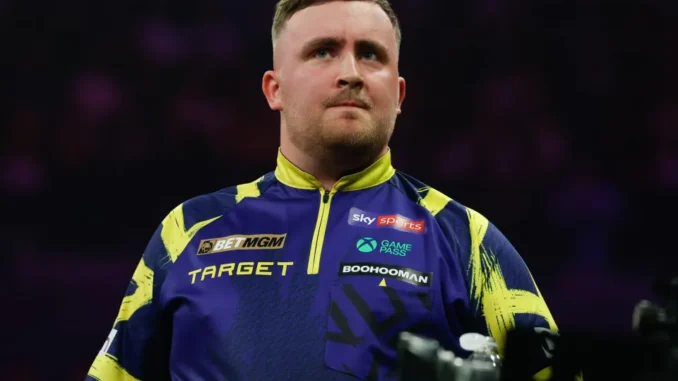
The meteoric rise of Luke Littler has already rewritten expectations in professional darts, but even at the summit of the sport, the teenage sensation is finding himself at the center of debate. This time, the spotlight isn’t just on his performances—it’s on his attitude, his preparation, and a blunt response to advice from one of the game’s most iconic figures.
That figure is Phil Taylor, a 16-time world champion whose voice still carries enormous weight in darts. Taylor has been watching Littler’s rapid ascent with admiration, but also with a sense that the young star still has room to refine certain aspects of his game—particularly when it comes to discipline and preparation.
Littler, now established as the world number one, has taken the sport by storm with his fearless style and extraordinary composure under pressure. His ability to deliver on the biggest stages has set him apart, especially considering his age. Yet, for Taylor, the concern isn’t about what Littler is doing right—it’s about what he might be overlooking.
Drawing from his own career, Taylor stressed the importance of consistent practice and routine. He has always been known for his relentless work ethic, often spending hours honing his craft even at the peak of his dominance. In his view, that dedication is what allowed him to maintain success over such a long period, and he believes it is something Littler should take seriously if he wants to stay at the top.
Taylor recalled a moment that, for him, highlighted the difference in approach. He described seeing Littler in a relaxed environment ahead of an exhibition, casually spending time on his phone rather than focusing on preparation. What followed made the situation even more striking—Littler went on to dominate his opponent with ease, showcasing the very talent that has made him a global sensation.
While many would see that as proof of Littler’s brilliance, Taylor interpreted it differently. To him, it suggested that the young star might be relying too heavily on natural ability rather than building the kind of disciplined foundation needed for long-term success. His message was clear: talent alone, no matter how extraordinary, is rarely enough to sustain greatness over time.
It was during this exchange that Littler delivered the response that has since sparked widespread discussion. When advised to dedicate more time to practice, he replied with a single, direct word: “No.”
That one-word answer has divided opinion. On one hand, it reflects the confidence that has defined Littler’s rise—a belief in his own methods and instincts that has carried him to the very top of the sport. On the other, it raises questions about whether such an approach could eventually become a limitation, especially as the challenges of being world number one continue to evolve.
Littler’s journey has been anything but conventional. Still in his teens, he has already achieved milestones that many players spend entire careers chasing. Major titles, record-breaking performances, and a fearless attitude have all contributed to his rapid success. He plays with a freedom that often leaves opponents struggling to keep up, and his ability to thrive under pressure has become one of his defining traits.
However, with that success comes a new level of scrutiny. Every aspect of his game—and increasingly, his behavior—is being analyzed. Crowds have not always been entirely supportive, and he has had to deal with criticism both inside arenas and online. These experiences have added layers of complexity to a career that is still in its early stages.
Taylor’s advice extended beyond practice routines. He also emphasized the importance of mental resilience, particularly in dealing with negativity and distractions. He suggested that stepping back from social media and focusing purely on performance could help Littler maintain clarity and avoid unnecessary pressure. It is advice shaped by years of experience at the highest level, where managing external noise becomes just as important as executing on stage.
The contrast between the two approaches is striking. Taylor represents a traditional mindset built on discipline, repetition, and structure. Littler, by comparison, embodies a more modern, instinctive style—one that prioritizes natural rhythm and confidence over rigid routines. Both approaches have their merits, but they also highlight a broader question within the sport: is there a single formula for sustained success?
So far, Littler’s method has proven incredibly effective. He continues to produce high-quality performances, often delivering when it matters most. His scoring power, finishing ability, and composure remain among the best in the game. Even when facing criticism or dealing with distractions, he has shown an ability to block out the noise and focus on the task at hand.
Yet, the history of darts suggests that staying at the top is often more difficult than getting there. Many players have experienced rapid rises, only to struggle with consistency or the mental demands of maintaining their position. This is the challenge Littler now faces—not just winning titles, but building a legacy.
Taylor’s comments, while direct, come from a place of respect. He has repeatedly acknowledged Littler’s talent and potential, making it clear that his advice is intended to help rather than criticize. In many ways, it reflects a passing of the torch, with one generation offering guidance to the next.
For Littler, the key will be finding the right balance. His confidence and belief in his own approach have been central to his success, and changing that too drastically could disrupt what makes him special. At the same time, remaining open to learning and adapting could be crucial in ensuring that his success is not just short-lived.
The one-word reply—simple, firm, and unapologetic—captures the essence of where Littler stands right now. It is the response of a player who trusts himself completely, who is unafraid to challenge even the most respected voices in the sport, and who is determined to follow his own path.
Whether that path will lead to sustained dominance remains to be seen. What is certain, however, is that Littler is not just influencing the way darts is played—he is also reshaping the conversation around what it takes to succeed. As his career continues to unfold, moments like this will only add to the intrigue surrounding one of the sport’s most fascinating talents.
Leave a Reply