
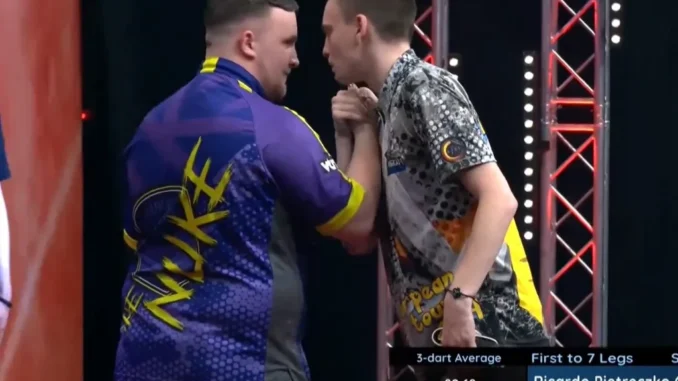
Luke Littler rival ABANDONS darts match after just two legs with average below 60 at Players Championship
A remarkable and unexpected moment unfolded at the Players Championship as one of Luke Littler’s rivals walked off his opening-round match after just two legs, following a rapid and dramatic collapse in performance that saw his scoring average drop to below 60.
The incident quickly became one of the most talked-about moments of the day, not because of a close finish or high-quality checkout drama, but due to the rarity of a professional darts player abandoning a match so early in a PDC ranking event. Within minutes of the first dart being thrown, the contest had already tilted heavily in one direction, and by the end of the second leg, it was effectively over.
From the opening exchanges, the struggling player looked unsettled and unable to find any rhythm. His scoring visits lacked power and consistency, with repeated missed trebles leaving him on low finishes that were never truly competitive. In contrast, his opponent settled quickly, punishing the loose scoring and building early momentum that proved decisive.
The first leg set the tone for what followed. Several missed darts at key doubles meant the player failed to capitalise on any small opportunities, and his opponent took control of the scoreboard. By the time the second leg began, frustration was already visible, with rushed throwing action and growing signs of discomfort at the oche.
As the match progressed, the statistics painted an increasingly bleak picture. The player’s three-dart average slipped below 60, a figure far removed from professional standards on the PDC circuit. At elite level, even in poor-performing matches, players typically expect to remain in the mid-80s or higher to remain competitive. Dropping below 60 is widely regarded as a sign of severe scoring breakdown, often accompanied by heavy pressure on doubles and a lack of consistent trebles.
The collapse in numbers appeared to mirror what was happening visually on stage. The player struggled to settle into any scoring rhythm, repeatedly failing to string together heavy visits, which in turn left him chasing the game almost immediately. The longer the match went on, the more one-sided it became, with his opponent continuing to apply pressure without needing to produce exceptional averages.
By the conclusion of the second leg, the situation had deteriorated to such an extent that the player made the rare decision to withdraw from the match entirely. After a brief exchange of handshakes with his opponent, he stepped away from the board, effectively conceding the contest. The opponent was immediately confirmed as the winner, progressing through to the next round of the Players Championship event.
For spectators watching inside the venue, the abrupt ending caused initial confusion. Some initially assumed a possible injury, equipment failure, or medical issue might have forced the retirement. However, it soon became clear that the decision was driven by performance struggles rather than physical inability to continue.
Incidents like this are extremely rare in professional darts, particularly in PDC Pro Tour events where players are generally expected to complete matches regardless of scoreline. The Players Championship series, which runs across multiple events throughout the season, is known for its fast-paced structure and high level of competition, with players often contesting several matches in a single day. As a result, consistency and mental resilience are essential traits.
The fact that the player involved has previously competed against Luke Littler adds further context to the attention surrounding the incident. Littler’s rapid rise through the darts world has created increased scrutiny on emerging and mid-tier professionals who regularly share the same tournament fields. Any unusual or dramatic moment involving players from this competitive circle tends to attract immediate interest from fans and analysts.
While Littler himself was not part of this specific match, the broader narrative of rising talent and competitive pressure on the Pro Tour circuit has become a recurring theme in darts coverage. Matches involving younger or less established players often highlight the fine margins between success and collapse at elite level.
In this case, the match appeared to swing quickly beyond recovery. Once the scoring rhythm disappeared, the player found himself under constant scoreboard pressure, which only increased the difficulty of regaining composure. In darts, momentum plays a critical role, and when it is lost early, it can be extremely difficult to reverse within the short format of a Players Championship match.
The psychological aspect of the game likely played a significant role in the outcome. Repeated missed trebles and missed doubles can quickly affect confidence, and once that confidence is disrupted, even simple scoring visits become harder to execute. The visible frustration during the match suggested that the player was struggling not just technically, but mentally as well.
For the opponent, the match offered a straightforward passage into the next round, although such early retirements can sometimes leave winners with little competitive rhythm going forward. While the result guarantees progression, it does not always provide the match sharpness that comes from a full-length contest under pressure.
Within the wider darts community, the incident is likely to prompt discussion about form management and the mental demands of the professional circuit. The PDC Tour requires players to compete frequently, often with little recovery time between events. This creates an environment where form can fluctuate rapidly, and where players must constantly reset after difficult performances.
Although no official detailed explanation was immediately provided at the venue, the early withdrawal will likely be reviewed informally within the context of tour conduct and professional expectations. However, unless there are underlying medical or disciplinary factors, such decisions are typically left to the discretion of the player in question.
For fans, moments like this serve as a reminder of the unpredictability of professional darts. While the sport often produces high-quality finishes, nine-dart attempts, and dramatic last-leg deciders, it can also produce abrupt and unexpected endings when form collapses rapidly.
As the Players Championship series continues, attention will now shift to upcoming rounds and other competitors looking to build momentum in the rankings. For the player involved in this early exit, the focus will inevitably turn to recovery, reflection, and preparation for the next opportunity to compete.
In a sport where confidence is as important as technical ability, bouncing back from a performance like this will be key. The early abandonment will be remembered as one of the more unusual moments of the tournament, highlighting just how quickly fortunes can change in professional darts when rhythm and scoring consistency disappear.
Leave a Reply