
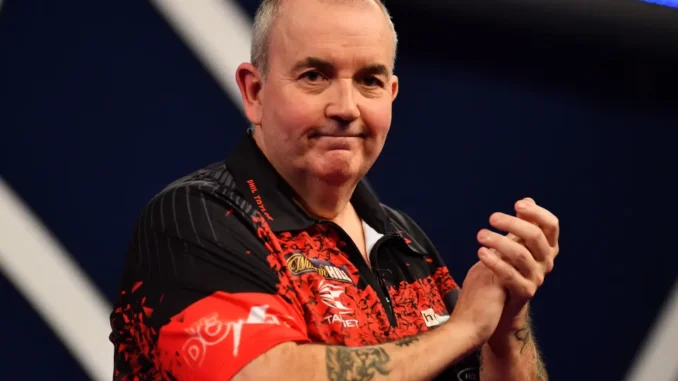
The struggles of Michael van Gerwen have become one of the most talked-about topics in modern darts, and now the legendary Phil Taylor has shared a frank assessment of what may be behind the Dutchman’s recent dip in form. According to Taylor, the reasons extend far beyond the dartboard, with personal challenges—particularly Van Gerwen’s painful divorce from his wife Daphne—playing a major role in his current slump.
For years, Van Gerwen was the dominant force in darts. At his peak, he was virtually untouchable, combining relentless scoring power with clinical finishing. His presence alone was enough to intimidate opponents, and his consistency made him the benchmark by which all other players were measured. Week after week, tournament after tournament, he delivered performances that seemed almost mechanical in their precision.
But the past couple of years have told a different story. While still capable of producing moments of brilliance, Van Gerwen has struggled to maintain the level of dominance that once defined him. Early exits from major tournaments, missed doubles at crucial moments, and a general lack of consistency have raised questions about what has changed.
Taylor believes the answer lies largely in Van Gerwen’s personal life. The split from his wife Daphne marked a significant turning point, not just emotionally but also in terms of his daily routine and responsibilities. After spending over a decade together, the end of the relationship forced Van Gerwen to adjust to a completely different lifestyle—one that inevitably affects his professional focus.
“He’s had a big change in his life,” Taylor explained. “At the minute now he’s like a single parent. It’s harder to travel, and his mind is occupied by other things.”
Those comments highlight a reality that is often overlooked in professional sports. Elite athletes rely heavily on structure, routine, and mental clarity. When those elements are disrupted, even the most talented individuals can struggle to perform at their best. For Van Gerwen, the balance between his personal responsibilities and the demands of a global darts schedule has become more difficult to manage.
During his dominant years, Van Gerwen was known for his obsessive dedication to practice. He would spend countless hours refining his technique, ensuring that every aspect of his game was as sharp as possible. That level of commitment requires not just physical effort but also mental focus—something that can be hard to maintain when dealing with significant life changes.
Van Gerwen himself has acknowledged how challenging the past year has been. Reflecting on his situation, he admitted that it has been one of the toughest periods of his career. “I’ve had a tough year,” he said. “You have to adapt yourself.” Those words underline the reality that he is not ignoring the problem but actively trying to find a way through it.
In addition to personal struggles, Taylor also pointed to physical issues that may have contributed to the Dutchman’s decline. Van Gerwen has dealt with injuries, including problems with his wrist and jaw—both of which can have a significant impact on a darts player’s performance. Precision is everything in darts, and even a slight physical discomfort can throw off timing, accuracy, and confidence.
When you combine these physical challenges with the emotional strain of a major life change, it becomes easier to understand why Van Gerwen has not been at his best. It is not simply a matter of form or technique; it is a complex situation involving multiple factors that all influence performance.
Despite the struggles, Taylor does not believe that Van Gerwen’s career is in decline beyond recovery. Instead, he sees this phase as part of a natural evolution. Even the greatest players, Taylor included, experience periods where their dominance fades and they must adapt to new circumstances.
“I think his lifestyle has just changed a little bit,” Taylor said. “But he will adapt to it.”
That belief in Van Gerwen’s ability to adjust is shared by many within the darts community. While he may not return to the same level of dominance he once enjoyed, there is still a strong sense that he has plenty to offer. His experience, skill, and competitive spirit remain intact, even if consistency has been harder to find.
The broader landscape of darts has also changed significantly in recent years. A new generation of players has emerged, raising the overall standard of the sport. Younger stars bring fearlessness, energy, and a hunger to challenge established names. This increased competition means that maintaining dominance is more difficult than ever.
For Van Gerwen, this adds another layer of complexity. Not only is he dealing with personal and physical challenges, but he is also competing in an era where the margin for error is smaller. Every missed opportunity is quickly punished, and every opponent is capable of producing world-class performances.
Yet, there have still been glimpses of the old Van Gerwen. In certain matches, he has shown flashes of the brilliance that made him a multiple-time world champion. Those moments serve as a reminder that the ability is still there—it is simply a matter of rediscovering the consistency that once set him apart.
Another important factor is resilience. Throughout his career, Van Gerwen has demonstrated an incredible ability to bounce back from setbacks. Whether it was early defeats or periods of criticism, he has always found a way to respond. This current situation may be one of his toughest tests, but it is not one that he is incapable of overcoming.
Taylor also suggested that expectations may need to be adjusted. Instead of expecting Van Gerwen to dominate every tournament, it may be more realistic to see him as a contender who can still win major titles, even if not as frequently as before. That shift in perspective reflects the natural progression of an athlete’s career.
What makes this phase particularly compelling is the human element behind it. Fans often see athletes as invincible figures, defined solely by their achievements. But Van Gerwen’s situation is a reminder that they are also individuals dealing with real-life challenges. Balancing personal responsibilities with the demands of professional sport is no easy task, and it is something that can affect anyone, regardless of their level of success.
As Van Gerwen continues his journey, the focus will be on how he adapts. Can he find a new balance between his personal life and professional ambitions? Can he overcome the physical issues that have hindered him? And most importantly, can he rediscover the consistency that once made him the best in the world?
There are no easy answers to those questions, but one thing is certain: writing off a player of Van Gerwen’s calibre would be a mistake. Great champions have a way of reinventing themselves, and if he can navigate this challenging period, there is every chance that he will once again be lifting major trophies.
For now, the darts world watches with interest. The story of Michael van Gerwen is no longer just about dominance and titles—it is about resilience, adaptation, and the ability to overcome adversity. And in many ways, that makes this chapter of his career just as fascinating as any of his triumphs.
Leave a Reply