
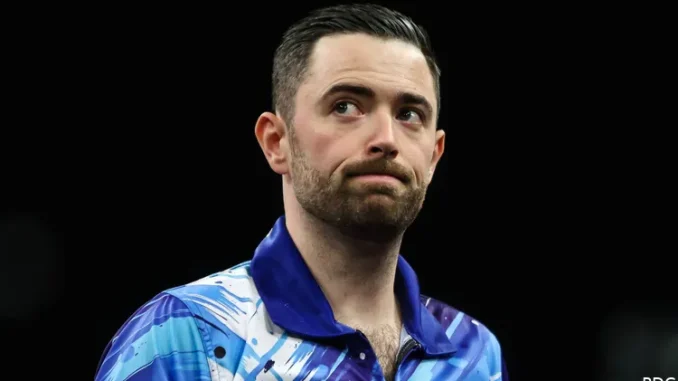
Former world champion Mark Webster has raised eyebrows with a candid assessment of Luke Humphries, questioning whether the normally unshakable star briefly lost belief in his ability to win during a difficult spell of form.
Humphries, known to fans as “Cool Hand Luke,” has built his reputation on composure, consistency, and a ruthless edge in crucial moments. Over the past few years, he has developed into one of the most dominant forces in professional darts, collecting major titles and establishing himself among the elite. His calm presence on stage and clinical finishing have made him one of the toughest opponents on the circuit.
However, even players of Humphries’ calibre are not immune to dips in form, and his recent performances have sparked concern. While the results themselves have been below his usual high standards, it is the manner of those performances that has drawn the most attention. Subtle signs—body language, hesitation, and missed opportunities—have led to questions about whether something deeper is affecting his game.
Webster, now a respected pundit and analyst, did not shy away from addressing those concerns. Speaking openly, he revealed that one particular performance left him genuinely puzzled. “I actually questioned whether he thought he could win last week,” he admitted, a statement that underlined just how unusual the situation appeared to him.
For a player like Humphries, whose success has been built on unwavering belief, such a suggestion carries weight. Confidence is a critical component in darts, where matches can hinge on a handful of key moments. A slight drop in conviction can have a significant impact, especially when it comes to finishing under pressure.
The performance that prompted Webster’s comments came during a challenging night in the Premier League. Humphries struggled to impose himself and ultimately fell to a heavy defeat, with his finishing proving particularly costly. Opportunities came and went, but he was unable to capitalise, allowing his opponent to take control of the match.
Normally, Humphries is among the most reliable finishers in the game. His ability to take out high-pressure checkouts has been a defining feature of his rise to the top. On this occasion, however, that sharpness deserted him. Missed doubles began to accumulate, and with each one, the sense of frustration seemed to grow.
According to Webster, the issue appeared to go beyond simple execution. It was not just that Humphries was missing chances; it was the way he approached them. There seemed to be a lack of conviction, a hesitation that is rarely associated with a player of his stature. That, more than anything, raised questions about his mindset.
The Premier League format offers little room for error. With weekly events and a highly competitive field, players must maintain a high level of performance to stay in contention. Momentum is crucial, and those who fail to find it early can quickly fall behind.
For Humphries, the campaign has been something of a struggle. Despite his pedigree, he has found it difficult to string together consistent results. A run of early exits has left him playing catch-up, and the pressure to deliver has only intensified as the weeks have gone by.
Webster acknowledged that there is still time for Humphries to turn things around but stressed the importance of acting quickly. The longer the struggles continue, the harder it becomes to regain momentum. A single strong performance can change everything, but it needs to come sooner rather than later.
Part of what makes this situation so intriguing is Humphries’ track record. This is a player who has repeatedly proven his ability to perform under the brightest lights. He has won major titles, defeated the very best in the world, and demonstrated a level of consistency that few can match.
That is why any suggestion of doubt is so striking. For most players, confidence fluctuates, but for Humphries, it has been one of his defining strengths. To see even a hint of that belief wavering is enough to prompt serious discussion.
In darts, confidence and rhythm are closely linked. When a player is in form, everything flows naturally. Scoring is effortless, finishing is clinical, and decisions are made instinctively. When confidence dips, even slightly, that rhythm can be disrupted. Throws that would normally feel automatic begin to require thought, and that hesitation can be costly.
Webster’s comments suggest that Humphries may have found himself in that position. The missed doubles and hesitant approach are often signs of a player searching for their rhythm. Breaking out of that cycle requires not just technical adjustments, but a mental reset.
There are also external pressures to consider. Competing at the highest level brings constant scrutiny. Every performance is analysed, every result dissected, and expectations remain high regardless of recent form. For a player like Humphries, who has set such lofty standards, anything less than excellence is immediately noticed.
The intensity of the Premier League adds another layer to that pressure. With matches taking place week after week, there is little time to reflect or reset. Players must adapt quickly, finding solutions in real time as the competition progresses.
Despite the concerns, there is a strong belief that Humphries has the tools to respond. His talent has not disappeared, and his achievements speak for themselves. Players of his calibre rarely stay down for long, and a return to form could come at any moment.
Webster’s remarks, while critical, also reflect a level of expectation. They are not the comments of someone writing off a player, but of someone surprised by what they have seen. In many ways, they underline just how highly Humphries is regarded within the sport.
The challenge now is for Humphries to rediscover the belief that has carried him to the top. That may come through a single big moment—a crucial checkout, a hard-fought victory, or a standout performance that reignites his confidence. Once that spark returns, the rest of his game is likely to follow.
The competitive landscape around him is as fierce as ever. Rivals are performing at a high level, and the margin for error is minimal. To climb back into contention, Humphries will need to combine his natural ability with renewed confidence and determination.
As the season unfolds, his response will be closely watched. Every match presents an opportunity to shift the narrative, to turn doubt into belief and struggles into success. For a player of his quality, that turnaround is always within reach.
Ultimately, Webster’s assessment highlights a fundamental truth about elite sport. Talent alone is not enough; belief is equally important. For Luke Humphries, the task ahead is not just about hitting the right numbers, but about stepping up to the oche with the conviction that he can win.
If he can rediscover that mindset, there is little doubt that he will once again look like the player who has dominated the sport in recent years. And when that happens, the questions surrounding his form will quickly be replaced by admiration for his resilience and ability to bounce back.
Leave a Reply